Improved environmental performance
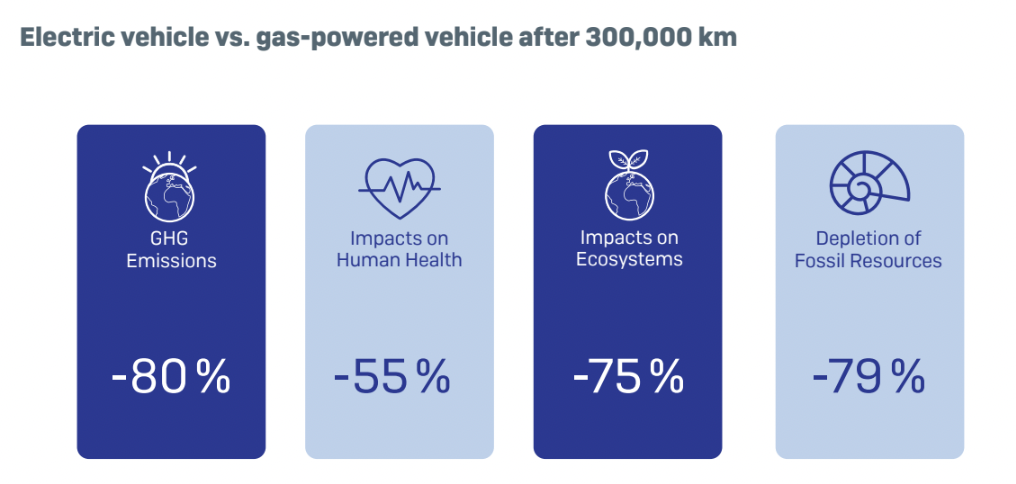
The analysis of an electric vehicle’s full life cycle shows that its environmental impacts are much less significant than those of a gas vehicle. This is especially true in Quebec, where a vehicle that runs on hydroelectricity emits up to 80% less greenhouse gases than its gasoline equivalent.
Lower environmental impact over the life cycle
Life cycle assessment studies are clear: the environmental impacts associated with electric vehicles are lower than those of gasoline-powered vehicles. This is particularly true in Quebec, where 99% of the electricity comes from renewable sources.
The latest tool, Pareto’s interactive electric and internal-combustion vehicle comparison tool, allows you to easily view and compare the environmental, social, and financial impacts of electric and internal-combustion vehicles on the market with a high degree of accuracy.
The environmental impacts of an electric car that has traveled 300,000 km are 55% to 80% lower than those of an equivalent conventional car.
The higher environmental impacts during the manufacturing of the electric vehicle are minimal compared to those avoided by not producing or burning gasoline.
Increasingly Cleaner Electric Vehicles
The environmental footprint of electric cars continues to improve.
In fact, more and more new electric vehicles are being manufactured using batteries from end-of-life vehicles. In reality, recycling electric vehicle batteries offers so many benefits that several companies are buying used vehicle batteries at high prices.
Furthermore, thanks to new industrial processes, battery manufacturing emits fewer greenhouse gases and requires fewer critical metals year after year. For example, a new generation of batteries, called Lithium-Iron-Phosphate (LFP), significantly reduces the need for rare minerals such as cobalt and nickel.
Gasoline vehicles are getting increasingly dirty
Today, manufacturing a gasoline-powered car has a smaller impact than producing an electric vehicle. But the trend has been reversed in recent years as gasoline-powered cars become more efficient through increased hybridization (with electric motors and batteries) and the use of light metals and composite materials.
More importantly, the gasoline that powers vehicles is becoming dirtier. The share of conventional oil (the kind that bubbles up from the earth on its own) is becoming scarcer as new deposits become increasingly rare. The "peak" of conventional oil is said to have been reached in 2016 and 2018. We are now entering the era of non-conventional oil: "shale oil" and "tar sands", which are very polluting to produce. In Quebec, 100% of the oil that fuels our cars comes from the tar sands of Alberta and from shale oil wells in the United States and Western Canada.
The EV battery and its end of life
Electric car batteries have a long lifespan: 200,000 to 500,000 km. Manufacturers generally offer an 8-year or 160,000 km warranty.
The circular industry of recycling batteries is just starting and the batteries of tomorrow's electric vehicles will have even smaller environmental impact, since they will be partly made using batteries from today's vehicles. At the end of their lifespan, batteries can be reused for energy storage purposes.
The source of energy to recharge the battery
In Quebec, 99.7% of electricity is generated from renewable sources that emit no greenhouse gases, which is an advantage compared to other parts of the world where electricity is generated from fossil fuels. It should be noted that, globally, the trend is toward decarbonizing energy sources.
Electricity Maps website lets you see in real time where electricity comes from all over the world and view the carbon intensity for each country or province. You’ll see electricity exchanges happening in real time… very informative!
Other recent studies point in the same direction
TThe vast majority of scientific studies support electrifying transportation. For more information, you can consult the of the most enlightening resources on the subject:
- Greenhouse Gas Reductions Driven by Vehicle Electrification across Powertrains, Classes, Locations, and Use Patterns (ACS), 2025 : This last study confirm that on average, a 300-mile range battery electric vehicle has emissions which are 31–36% lower than a 50-mile range plug-in hybrid electric vehicle (PHEV), 63–65% lower than a hybrid electric vehicle, and 71–73% lower than an internal combustion engine vehicle.
- Life-cycle greenhouse gas emissions of U.S. sedans and SUVs with different powertrains and fuel sources. : The latest report that compares GHG emissions from gasoline, hybrid, plug-in hybrid and electric vehicles. Depending on their size (“sedan” cars versus mid-size SUVs). We can conclude that in a Quebec context (nearly 100% renewable electricity), the electric vehicle avoids between 83% and 85% of emissions compared to a gasoline model. The electric car sees the excess emissions linked to the manufacturing of its battery compensated from 24,500 km. For the SUV, the balance point is 19,000 km due to the greater fuel consumption of this type of vehicle.
- Life Cycle Analysis Comparaison (Fuel Institute), 2022 : A detailed report that compares the impacts of electric vehicles and gasoline vehicles, in the context of the United States. The report demonstrates that electric vehicles can significantly reduce greenhouse gas emissions, as well as total costs of ownership for the consumer.
- Gasoline versus electric cars? Here’s how their life cycle emissions compare in Canada : detailed article written by analyst Barry Saxifrage of the Canada's National Observer. A comparative analysis of the impacts on the fight against climate change of the electric car, between Canadian provinces.
- A global comparison of the life-cycle greenhouse gas emissions of combustion engine and electric passenger cars (ICCT), 2021 : very comprehensive article that compares vehicle emissions with all available forms of energy and world region, in Europe, the United States, China and India. This analysis also balances the foreseeable evolution of the various energy productions until 2030.
- CarbonCounter (MIT) 2021: tool developed by MIT to compare the environmental footprint of different models of electric vehicles. All parameters are adjustable and documented.
- Hoekstra, A. The Underestimated Potential of Battery Electric Vehicles to Reduce Emissions. Joule, Volume 3, Issue 6, 19 June 2019: article on the underestimated potential of electric vehicles to reduce greenhouse gas emissions.
- Knobloch, F., Hanssen, S., Lam, A. et al. Net emission reductions from electric cars and heat pumps in 59 world regions over time. Nat Sustain 3, 437–447 (2020) : article which analyzes the impact of electrifying transportation and the use of "heat pumps" (for heating and air conditioning) around the world, in relation to the announced decarbonization of electricity production.
- Comparative Life Cycle Assessment of the Potential Environmental Impacts of Electric and Conventional Vehicles in a Quebec Context (2016). At the request of Hydro-Québec, the International Reference Center on the Life Cycle of Products, Processes, and Services (CIRAIG) conducted a comparative life cycle assessment of electric vehicles and internal combustion engine vehicles under Quebec usage conditions.


For more information
- Environmental Impact of Electric Cars Over Their Entire Life Cycle (news article)
- Myth or Reality: is an electric vehicle more polluting than an internal combustion vehicle? (video capsule) - french only
- Demystifying the environmental impact of electric vehicles (video capsule) - french only
