Energy Demand: The Role of Electric Vehicle Owners
12 November 2026
More and more Quebecers are making the switch to electric vehicles (EVs). While this shift is changing our energy needs, EV charging offers a major advantage: its great flexibility. By simply scheduling it, charging can take place at the most opportune times for the grid, without imposing any constraints on daily life. Better yet, it can earn you cash rewards. Here’s how it works.
This article was produced in collaboration with Hydro-Québec.
More and more people are switching to electric cars, which is a good thing for reducing GHG emissions. However, this transition presents a major challenge: managing the increase in our energy needs. According to the latest estimates from Hydro-Québec, by 2032, personal EVs alone are expected to add 3.3 TWh to Quebec’s electricity demand, representing 16% of the projected increase.
By comparison, data centers are expected to consume nearly 4.9 TWh of additional electricity by 2032—equivalent to 24% of the projected increase.
The Crux of the Matter: Winter Peak Demand
The crux of the matter with EVs isn’t a shortage of energy, but rather avoiding everyone consuming it at exactly the same time.
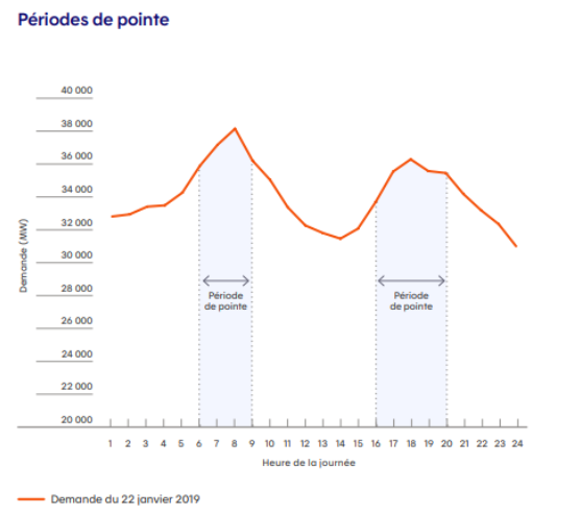
The situation is particularly critical in winter. Since more than 80% of Quebec households use electricity for heating, there is very high demand on extremely cold days. These “peak periods” inevitably occur in the morning and evening.
If all EV owners start charging their vehicles when they get home from work—at the same time that heaters kick in and dinner is cooking—the grid comes under heavy strain.
On the other hand, if EV owners delay charging their vehicles until off-peak periods—for example, between 10 p.m. and 5 a.m.—the strain on the power grid is reduced, and the EV will still be fully charged by morning when it’s time to use it.
How Can You Help? Practical Tips!
As an electric vehicle owner, you have significant power to help shift energy demand—effortlessly (and save money at the same time):
- Schedule your charging for nighttime: this is the simplest and most effective step you can take. Use your vehicle’s or charging station’s app to set charging to start late at night (for example, after 10 p.m.), well outside peak periods.
- Take advantage of dynamic pricing: the Flex D rate rewards customers who shift their energy consumption. Between December 1 and March 31, during peak events (lasting up to 4 hours per event and 120 hours per winter), you can earn financial rewards by reducing your energy consumption (for example, by avoiding charging your EV during these periods, delaying the start of your electric heater, or avoiding the use of your appliances and water heater).
- Automate with home automation: Services like Hilo let you automate your energy management during peak events. By signing up for the service, the system can intelligently manage the temperature of your thermostats, the power to your water heater, and even certain models of charging stations during peak periods. You choose how actively you participate in the challenges. A promotion is currently available for the installation of smart thermostats and a water heater controller starting at $0. In exchange for your efforts to reduce your energy consumption, you’ll receive cash rewards.
Changing our energy consumption habits requires only a few adjustments, but collectively, these small steps to manage power usage make a huge difference in the stability of our electric grid.
*With a target of more than 1.7 million EVs by 2032.
Webinar to learn more (in french only)
Watch this recorded webinar, hosted by Hydro-Québec, on energy needs related to the electrification of transportation.
