Guide 101: Charging on the Go
Most EV drivers occasionally charge their vehicles on a public network, generally during long trips that surpass the vehicle's range.
Today, it’s very easy to travel almost everywhere in Quebec by electric car. Charging stations are located in a wide variety of locations, close to businesses and services.
In this guide, you’ll find:
- Types of public charging stations
- How to find public charging stations
- Public charging networks in Canada
- Interoperability of charging networks
- How to start charging
- Will I need an adapter?
- Public charging costs
- How to pay for charging at a public station
- Best practices at public charging stations
- Learn on Video
Types of Public Charging Stations
On the road, there are two types of public charging stations:
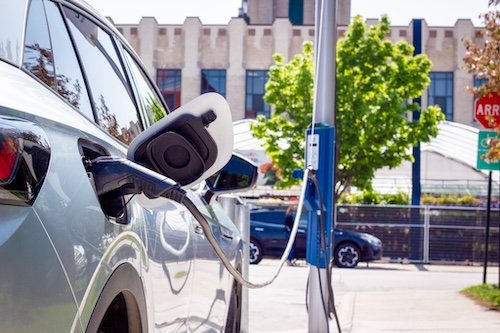
1) Level 2 charging stations (240 V)
- These are used when you plan to spend a few hours at your destination, such as at a museum, movie theater, shopping center, restaurant, or hotel.
- Level 2 stations have a charging speed similar to home charging stations: you gain 30 to 40 km per hour of charging.
- Charging is usually billed by the hour or per session, and sometimes charging is offered for free.
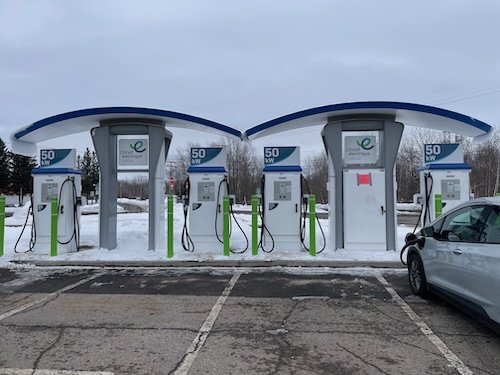
2) Level 3 stations (fast or ultra-fast chargers, including Tesla Superchargers)
- These are often located near major highways.
- They’re used to charge quickly and gain the range needed to reach your next destination.
- The charging rate is approximately 150 to 200 km per hour of charging, but at ultra-fast stations, it can even reach 300 km per hour. You typically charge for between 10 and 30 minutes, depending on your range needs.
How can you find public charging stations?
1) Apps
To locate charging stations from different charging networks, electric vehicle drivers can download an app that lists all public charging stations, such as the ChargeHub app. There are many other apps that list charging stations, and most charging networks have their own apps.
The Google Maps app can also find charging stations along your route, and you can filter your search to show only Level 2 or Level 3 stations.
Most apps also let you check the availability of charging stations.
2) Your electric vehicle’s navigation system
On most newer electric vehicles, your car’s navigation system or GPS will suggest charging stations along your route, taking into account the range you’ll need to reach your destination.
Public Charging Networks in Canada
There are more than 30,000 public charging stations in Canada, and that number is constantly growing. Here are the main networks you’ll find on the road.
By clicking on a specific network, you’ll find instructions on our partner Chargehub’s website on how to use and pay for that network’s charging stations.
- BC Hydro(in British Columbia)
- ChargePoint
- Circuit Électrique(in Quebec)
- Flo
- IVY (in Ontario)
- RechargÉco (in Quebec)
- Tesla
Interoperability of Charging Networks
Several networks may be interoperable with one another. To avoid having to download all the apps for every network, use the Agora tool to find out which networks are interoperable.
For simplicity’s sake, we invite you to download and use the app from our partner Chargehub, which lists charging stations from all networks and at all charging levels. Using this app, you can start and pay for your charging sessions.
How do you start charging?
There are many charging networks, just as there are many gas stations. They all work in a similar way.
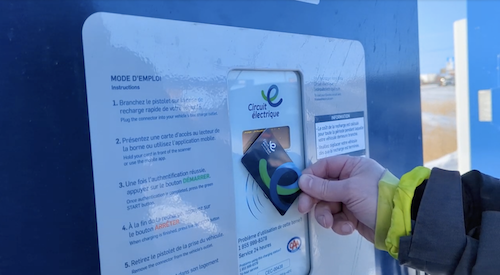
- You must start the charging session using a mobile app or a physical card (or simply by plugging in the charging gun with Autocharge technology).
- Plug the charging gun into your vehicle’s charging port.
- You must then confirm that charging has started—either in your vehicle, at the charging station, or in the app.
Will I need an adapter?
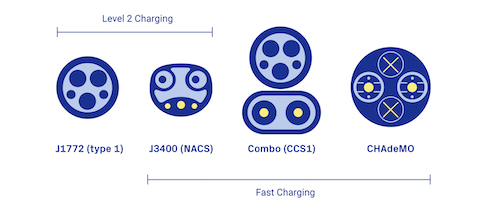
It’s important to check what type of charging port your electric car has: a NACS port, popularized by Tesla, or a J1772 port. The NACS port is becoming the standard today. To charge your car on the road at any charging station, it’s very convenient to have an adapter that you can attach to the charging gun.
Public Charging Costs
Level 2 Charging Stations (240 V)
- Between $1 and $3 per hour, or between $0 and $10 per session. Sometimes, charging is offered for free by the facility hosting the charging station.
Fast-charging stations
- Billing is often per kW, so you pay for the energy you put into your car, just as you pay for the gas you put into a gas-powered car. Rates vary depending on the charging network.
Keep in mind that with an electric car, most charging will take place at home, where electricity is very inexpensive. For example, in Quebec, fully charging an electric car with a 400 km range will cost less than $10.
How do you pay for charging at a public charging station?
There are different ways to pay for charging, depending on the province and the charging network.
1) Apps
You can use the app for the network where you plan to charge, or an app like Chargehub, which lets you pay for charging sessions across all networks directly within the app. Simply add funds to the app using a credit card. Your account will be automatically charged after the charge is complete.
2) By credit card
Some charging stations allow payment by credit card directly at the station, but this isn’t yet the norm.
3) Autocharge technology
Autocharge technology is rapidly gaining traction across several charging networks. Simply plug in the charging gun. The charging station recognizes the associated account and bills it directly once the charging session is complete.
Best Practices at Public Charging Stations
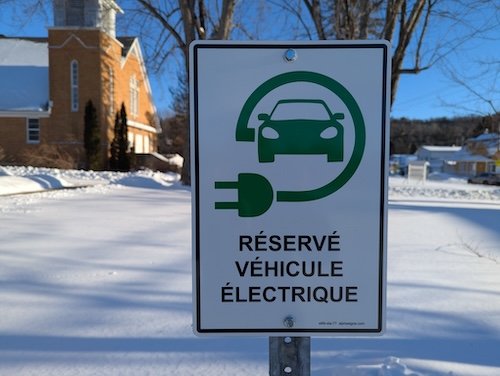
Spaces Reserved for Charging. It’s the Law!
The Highway Safety Code stipulates that “only electric road vehicles and […] plug-in hybrids may be parked in a space reserved for charging […] if they are connected to the charging station.” Violators are subject to a fine of $100 to $200.
You do not need to stay near the vehicle while it’s charging. Electric vehicle drivers should note the estimated end time displayed by the car or in the charging station’s app to ensure they return before charging is complete. However, once the charging session is finished, you must move your vehicle to free up access to the charging station.
Recommendation: Charge to a maximum of 80% during fast charging
At fast-charging stations, it is recommended to stop charging when the battery level is around 80%, as the charging speed decreases as it approaches this point.
Since public charging is billed by the minute, it becomes increasingly expensive beyond 80%, and some charging networks increase their rates once the battery level exceeds 80%.
If you need more power, it may be more cost-effective to continue your trip and plan another stop at a fast-charging station.
Learn More
To learn more, watch our video course on charging on the go (in french) :
